
NeuroConv 0.10.0 Release

NeuroConv 0.10.0 Release
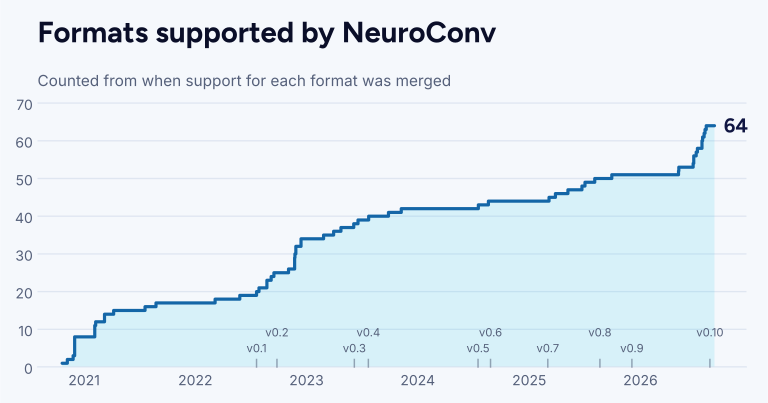
We are pleased to announce the release of NeuroConv 0.10.0, the largest release the project has had. It covers everything since v0.9.0, the last release we wrote about here, including the v0.9.1, v0.9.2 and v0.9.3 patches. Fiber photometry and discrete events are first-class modalities now: new interfaces for five photometry formats and six event sources, metadata templates to assist the annotation of the datasets, and improved documentation and how-to guides for making sense of them. Intracellular electrophysiology was rebuilt around one interface per electrode and the NWB sweep tables. NeuroConv now converts 64 formats, thirteen of them added in this stretch. Test it today:
pip install --upgrade neuroconvNeuroConv now supports the latest versions of pynwb and hdmf, and requires pynwb>=4.0.0 and hdmf>=6.1.0.
Events
NeuroConv now writes events as EventsTable objects into nwbfile.events, the type NWBEP001 brought into the core standard and pyNWB 4 ships. The supported sources are:
- Doric: digital IO from
.doricHDF5 files and from CSV exports, modern and legacy EPConsole layouts - Neurophotometrics: the two-column stimuli CSVs
- TDT: epocs, with or without durations
- Intan: the digital input and output words
- SpikeGLX: the NIDQ digital lines
- Plain CSV: any table with timestamp, event type, value and duration columns
To make annotating this data easier, we added two how-to guides:
- Annotating events metadata: naming the table and its columns, replacing the raw codes a rig writes with readable labels, describing what each label means in a
MeaningsTable, and pooling event types from one interface or from several into a single shared table. - Extracting events from a sampled signal: which signals to read, how each becomes a two-valued line, and which of its transitions become event timestamps.
Fiber photometry
Fiber photometry went from one supported format to five, all of them written in the ndx-fiber-photometry extension format through a shared base interface. The supported formats are:
- Doric:
.doricHDF5 files and Doric Neuroscience Studio CSV exports - TDT: tanks
- Neurophotometrics: raw NPM output
- Plain CSV: any table of timestamps and fluorescence columns, for systems with no dedicated interface here
The provenance chain the format asks for, the fibers, indicators, excitation sources and their models, is more than any acquisition file records. To make annotating it easier, we added:
- Metadata Templates: the full structure published as YAML and JSON to fill in by hand, and returned in code by
get_metadata_template()with every field only the experimenter can supply left asNone. - How to Annotate Fiber Photometry Metadata: builds a
FiberPhotometryTableone step at a time, starting from a conversion with no metadata at all.
We have also added support for GuPPy, the fiber photometry analysis pipeline:
GuppyInterfaceadds GuPPy’s outputs to a file you already have. Hand it an NWB file and each recording site is linked to theFiberPhotometryTablerows its fibers already occupy there. Point it at a new path instead and the source is exported with the outputs added. GuPPy’s own analyzed onsets are written as anEventsTableinnwbfile.events, so every peri-event product reaches the occurrences it was built from.GuppyConverterconverts a whole session at once, the raw acquisition, the raw events and GuPPy’s analyzed outputs into one file. The acquisition format is chosen withacquisition_format("tdt","csv","doric"or"npm", all four installed byneuroconv[guppy]), and its series are grouped by excitation wavelength.
Improved metadata annotation for optical physiology
An optical physiology conversion writes several objects that point at each other. A MicroscopySeries names the ImagingPlane it was recorded through, that plane names its Device, and a PlaneSegmentation names the plane it segments. Those links used to be positions in a list. That was error prone and hard to get right: annotating a two-channel recording meant working out which entry was which channel before editing it.
In this release we introduced a new metadata schema for optical physiology. Each entry now has a name you choose and points at the others by that name. To improve the user experience, and the documentation of the new format, we also added the following:
- How to Annotate Optical Physiology Data: builds the structure for a real recording, starting from a conversion with no metadata at all.
- A new method,
get_metadata_template(), returns the whole structure the writer expects, sized to what the file will actually hold, with the cross-references already resolved and every field only the experimenter can supply left asNone. What comes backNoneis exactly what the source could not tell us, so the blanks are the checklist. - The new Metadata Templates page publishes those same structures as YAML and JSON files, to fill in by hand, for both imaging and segmentation data.
Improved intracellular electrophysiology support
Intracellular electrophysiology gets a section of the conversion gallery of its own, two formats, and the tables NWB defines for organizing sweeps:
- The Axon Binary Format, read by
AxonIntracellularInterfacein place of the deprecatedAbfInterface. Each instance handles one electrode in one file, written as a single continuousPatchClampSerieswith one intracellular recordings row per sweep. - The voltage recordings Bruker PrairieView writes alongside two-photon imaging, with the per-cycle files combined into a single series on one timeline and one intracellular recordings row per cycle.
AxonIntracellularConverterandBrukerVoltageRecordingConverterwrite the icephys hierarchy tables. The intracellular recordings table carries the sweep structure, each sweep a row addressed as a range of the electrode’s series, andSimultaneousRecordings,SequentialRecordings,RepetitionsandExperimentalConditionsare assembled above it across the channels and protocol files of one cell. Asweepsintervals table carries each sweep’s start and stop time as well, so tools that read NWB intervals, such as pynapple, surface them with no icephys-specific code.
New interfaces
An interface reads one source of data and writes it into an NWB file, and it is the unit you reach for when a conversion needs one thing from one instrument. In this release we added interfaces for the following:
- VAME: behavioral segmentation, written both as the faithful
ndx-vameseries and as a curatedndx-ethogrambout timeline - MountainSort: spike sorting, from the
firings.mdaoutput of v4 and earlier - XClust: spike sorting, from its
.CELfiles - Intan stimulation current: the RHS2000 stim channel
- Intan digital lines: the input and output words, written as events
- Bruker Prairie View: single-plane, volumetric and multi-channel folders through one interface, replacing the four deprecated single-plane and multi-plane classes
New converters
Converters discover what an experimental session contains for a given format and write all of it in one call. Their role is to gather the data for you, so you do not have to assemble the interfaces yourself. In this release we added converter support for the following formats:
- ScanImage: every channel of an acquisition, planar or volumetric, whether it sits in one file or spans many
- Thor: every channel of a ThorImageLS acquisition
- Bruker Prairie View: every channel of a folder, planar or volumetric
- Suite2p: every plane and channel of an output folder
- Open Ephys: every stream of a binary session, each neural stream as its own
ElectricalSeriesand the ADC and NI-DAQ streams asTimeSeries - Intan: every stream of a session, see the next section
Full Intan support
The newly added IntanConverter supports the complete list of streams an Intan
acquisition session typically produces, on both .rhd and .rhs files. It reads the header, discovers which
of them a session holds, and routes each one for you:
- The amplifier channels, RHD2000 and RHS2000 alike
- The auxiliary input channels of an RHD2000
- The USB board ADC input and output channels
- The DC amplifier channels of an RHS2000
- The stimulation current of an RHS2000
- The USB board digital input and output words, written as events
All three of the on-disk layouts RHX can write are covered, and the layout is inferred from the header so the API is the same for each:
- Traditional Intan File Format, the single
.rhdor.rhsfile - One File Per Signal Type, pointed at the session’s
info.rhdorinfo.rhs - One File Per Channel, pointed at the same header file
We also support the traditional format’s “create a new save file every N minutes” option: the rotated files are read as one continuous recording, so a split session converts in a single call.
Other improvements
- Improved Neuropixels provenance: SpikeGLX and Open Ephys recordings write the attached Neuropixels probe’s identity, a
DeviceModelcarrying the manufacturer and model number as probeinterface catalogues them, and aDevicecarrying the unit’s serial number. Those values are read off the probe itself, so the file states which probe was used and its geometry can be rebuilt from that identity alone. - Enhanced EDF support: EDF recordings take a
stream_name, withget_stream_nameslisting what a file offers, so a file that samples some of its signals at a different rate than the rest converts one stream at a time. A recording whose channels were each autoscaled to their own range can go into a singleElectricalSeriesthrough the newdata_representation="physical_units"option, which folds each channel’s gain and offset into float data. A new how-to guide says which of the two applies to a given recording. The subject fields the header carries also reach the file now, including the patient’s sex, andexperimenteris written as the list the schema asks for. - Proper detection of Inscopix volumetric recordings: Inscopix recordings decide their plane count from the file’s own
microscope.multiplane.enabledflag, so a single-plane recording converts and a multiplane one raises a message saying it is not supported yet. Files too old to carry the flag warn and load as single-plane. - Proper support of Miniscope behavioral recordings:
MiniscopeConverternow writes the behavior videos of a session driven by a User Config file, discovered fromdevices[cameras]in that config, each with the timestamps of its owntimeStamps.csvand aligned to the same session start time as the imaging. The Miniscope’s own settings reach the file too,gain,led0,frameRate,framesPerFile,compressionand the sensorROI, where before only its name did, and the settings that differ between recordings are reported per recording. - Chunking and compression support for image data: images are chunked and compressed by default now, both the ones
ImageInterfacewrites and the ophys summary images, where they had been written raw, so a file full of them is a fraction of the size it used to be. They also carry the dtype of the source,uint8oruint16as the case may be, rather thanfloat64. - Dataset conversion documentation: a new converting multiple sessions guide covers the loop over
LocalPathExpanderresults that converts one session at a time, and then what to do with the folder, uploading it to a Dandiset or reorganizing it into a BIDS layout withnwb2bids.
Also in this release
The shape of the metadata dictionary itself changed: hardware now lives in a top-level metadata["Devices"] registry keyed by a name you choose, and the annotation guides linked above show the new shape in use. Nothing has to move at once. get_metadata(use_new_metadata_format=False) still returns the old shape as an opt-in, and metadata written in it is still accepted and converted on the way in behind a warning, so a pipeline can migrate one conversion at a time. See the full changelog for everything else, including the bug fixes and the deprecations with their removal dates.
Coming from v0.9.0 you also pick up the v0.9.1, v0.9.2 and v0.9.3 patches, which were maintenance. The one to know about is that every data interface now takes keyword-only arguments: __init__ accepts file_path, folder_path or file_paths positionally and nothing else, so a call that passed later arguments by position has to name them.
Fiber photometry and events take the front seat this release, but the conversion gallery covers 64 formats across ecephys, ophys, behavior, sorting and intracellular electrophysiology. Have a look for the ones you record. If something is missing, or a format you use does not behave the way you expect, please open an issue. We take requests for new formats, and the ones people ask for are the ones that get built.