
What Happens When the Cost of Intelligence Drops 100x
Progress in large language models is usually reported as what the best model can now do that no model could do before. That is the direction that produces headlines, and it has indeed been truly incredible. Each step up at the top of the range lets a model handle a kind of task that was previously out of reach, whether that is fixing a bug that spans a whole codebase or, lately, making progress on outstanding mathematical problems that had not been solved by anyone.
There is a second direction of progress that gets less attention, which is how cheaply a given level of capability can be bought. A great deal of useful work does not require the smartest model available, but a model that is good enough, applied many thousands of times. Reading every scientific paper on a topic, checking every contract in an archive for a particular clause, or summarizing every thread in a large discussion forum are tasks of this kind. For these, the question is not whether a model exists that can do the job, but whether it can do the job ten thousand times within a budget. The ceiling unlocks new kinds of tasks; the floor unlocks volume.
When you pick a model for an application you are trading off how capable it is against how much each call costs. For agentic coding I have focused almost entirely on capability, with the general sense that the improved quality of the work is worth the money, even when far cheaper models exist that are reasonably capable. My attention was recently drawn to the cost of the floor. We are measuring how often datasets shared on the DANDI Archive are reused in later publications, which means reading on the order of ten thousand candidate papers with a model and asking of each one whether it actually reused the data. At today’s prices a full pass over the corpus costs a little over a hundred dollars with a model whose capability was at the frontier in the spring. At the prices of this past March, the same pass with the same level of capability would have cost several thousand dollars, and a year ago that capability was not available at any price. That change in the floor is what turned the analysis from a thing we could do on a sample into a viable project. I have been surprised by the progress across the cost spectrum, particularly how intelligent cheap models have become.
Artificial Analysis has been benchmarking intelligence and price across hundreds of models for a couple of years, and enough of that data is accessible to reconstruct the tradeoff. In particular, this plot shows the intelligence index vs. the cost per task, providing a realistic cost estimate for different levels of model capability. The top line is what they define as the “Pareto line,” the most capable models at a given price point. This line describes the true frontier of LLMs. I pulled data from artificialanalysis.ai and looked at how the Pareto frontier has moved as new models have been released. I think it is worthwhile to take a beat to review this progress and make some predictions for the next few months.
The short version: the level of intelligence that cost $1.22 per task in February costs $0.022 today, a 56x drop in under six months, and the rate of decline is accelerating. At the measured pace, a 100x drop for a given capability level takes about a year, and the question worth asking is not whether that happens but what it changes.
The Artificial Analysis Intelligence Index
The capability axis throughout this post is the Artificial Analysis Intelligence Index, so it is worth being clear about what that number is. The current version, v4.1.1, is a weighted average over nine evaluations grouped into four categories: agentic tasks at 34%, coding at 24%, scientific reasoning at 24%, and general capability at 18%. The weighting reflects where the field’s attention is: a third of the score comes from a model’s ability to complete multi-step agentic work, not from answering exam questions. The component evaluations, their weights, and the scoring details are documented in Artificial Analysis’s intelligence benchmarking methodology.
What you end up with is a single number that represents model capability, sort of like an IQ for LLMs. It isn’t perfect, and two models with the same score may have different strengths, but I have found that this score does a reasonably good job of indicating a model’s capability.
As a reference point, Anthropic’s “Claude 4.5 Sonnet (Reasoning)” was for me and many others the first time a model felt capable enough to use in an agentic harness for writing code. At the time I was using Cline, and this model provided substantial productivity gains over auto-complete and copy/paste workflows. That model had an intelligence score of 37.4 (based on today’s intelligence scoring system). The top current model is Claude Opus 5 max effort, at 63.1.
To give a more visceral sense of what the different index levels mean, I borrowed Simon Willison’s pelican benchmark: prompt a model with “Generate an SVG of a pelican riding a bicycle” and look at what comes back. It is not what the index measures, but it is a task anyone can judge by eye. The panels below use the GPT-5.6 family at four points on the index: Luna at low, high, and xhigh effort, and Sol at max effort. I generated three samples per model and show the first one; all of them are in the site repository.

GPT-5.6 Luna (low)

GPT-5.6 Luna (high)

GPT-5.6 Luna (xhigh)

GPT-5.6 Sol (max)
The progression is visible: more detail, better proportions, and a pelican that is clearly riding the bicycle instead of hovering over it.
Measuring Cost per Task
Cost per token is easily available, but different models can use a very different number of tokens, so a better indication of the cost of a model needs to take this into account. Cost per task is Artificial Analysis’s own measured number: the average cost in USD to run one task from their Intelligence Index evaluation suite, including the input, reasoning, and answer tokens actually billed during the run. The website displays it but the free API tier does not include it, so I scraped it from the data embedded in each model’s page on the site, covering both the models they currently benchmark and retired models whose pages still carry the measurement (older Claude Opus and Sonnet versions, the GPT-5.x line, and others). That yields measured cost for 137 models reaching back to DeepSeek V3 in December 2024, each paired with a release date and an Intelligence Index score on the current scale.
How the Frontier Has Moved
The charts in this section are a snapshot from August 19, 2026, the date this post was written. A live version of both charts and the tier table, refreshed every week from the same source, is on the LLM Cost Frontier dashboard.
The chart below plots intelligence against measured cost per task and traces the Pareto frontier, the cheapest way to reach each intelligence level, as it stands today and as it stood at two month intervals over the past year, using each model’s release date to reconstruct what was available. The chart builds up one frontier at a time, pauses on the full picture, and repeats; use the button to stop it. Hover any point for the model behind it.
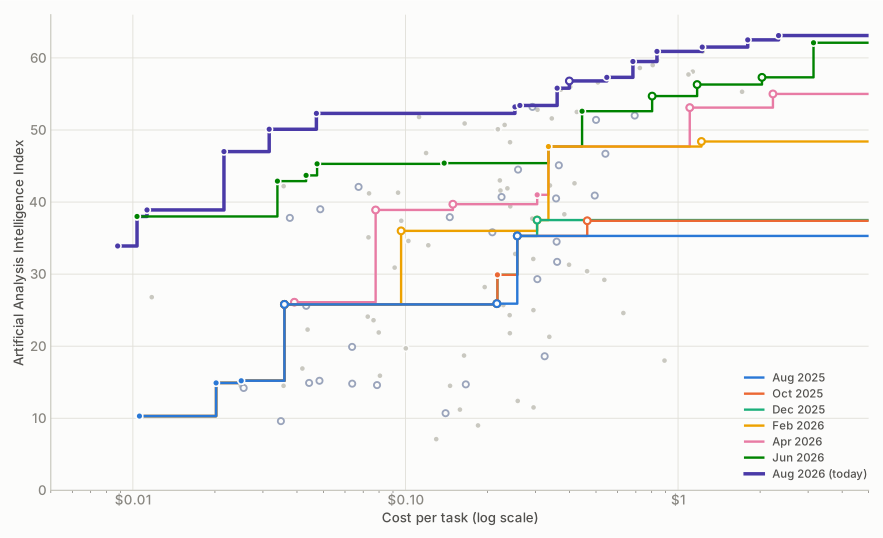
Each successive frontier sits above and to the left of the last: more intelligence at the same cost, or the same intelligence for less. The pace of that movement is accelerating. Through the second half of 2025 the frontier inched forward: only two small bumps between August and October, and a single one between October and December. The February and April frontiers each moved a large part of the curve, and the last two snapshots have replaced the frontier almost entirely, with ten of the eleven June frontier models new since April and fifteen of today’s sixteen new since June.
The right edge tells the capability story. The ceiling of the frontier rose from index 35.3 in August 2025 (GPT-5 at $0.26 per task) to 37.4 that October (Claude 4.5 Sonnet), 48.4 in February (Claude Sonnet 4.6), 55.0 in April (Claude Opus 4.7 at $2.23), 62.1 in June (Claude Fable 5 at $3.14), and 63.1 today (Claude Opus 5 at $2.34): twenty eight Intelligence Index points in a year. The left half shows the rising intelligence of cheap models. As of August 19, 2026, the GPT-5.6 Luna effort ladder now owns almost everything below index 52, with the level that was the August 2025 ceiling available for $0.0088 per task. The June 2026 frontier was unusually dominated by open weights models: six of its eleven models were open (MiMo-V2.5, DeepSeek V4 Pro, MiniMax-M3, and GLM-5.2 among them), and they held the whole middle of the range from index 38 to 53. In earlier snapshots open models appeared only at the bottom of the range, and today, after the GPT-5.6 Luna release, only two of sixteen frontier models are open.
Note that a single model can cover a large part of this range through different reasoning levels: the GPT-5.6 Luna ladder runs from $0.0088 at low effort to $0.047 at max and covers the whole lower half of the frontier, while Claude Opus 5 spans $0.43 at low effort to $2.34 at max and buys about ten Intelligence Index points along the way. Effort is now a key dial in the cost/intelligence trade-off, and as a consequence, cost and intelligence are inextricably linked.
The records plot below tracks the cheapest measured cost per task achieved by any released model at or above a given Intelligence Index tier. The series reaches back to mid 2025 for the lower tiers, and higher tiers appear when they become available.

| Tier | First measured crossing | Cost collapse | Halving time |
|---|---|---|---|
| Index ≥ 30 | Aug 2025 (GPT-5 high) | 29x | ~73 days |
| Index ≥ 40 | Feb 2026 (Claude Sonnet 4.6) | 56x | ~28 days |
| Index ≥ 50 | Mar 2026 (GPT-5.4 xhigh) | 35x | ~29 days |
| Index ≥ 60 | Jun 2026 (Claude Fable 5 max) | 3.8x | ~34 days |
A capability level is first reached by a large frontier model at a premium price. After some time, cheaper models arrive at the same level, and the record steps down by an order of magnitude or more. The ≥ 40 tier opens with Claude Sonnet 4.6 in February at $1.22 per task, undercut within two days by Gemini 3.1 Pro Preview at $0.33; MiMo-V2.5-Pro, an open weights model, cut the record to $0.034 in April, and GPT-5.6 Luna on high effort holds it at $0.022 today. The ≥ 50 tier follows the same arc a month behind: GPT-5.4 crossed it in March at $1.10, GPT-5.5 and then GLM-5.2 and Grok 4.5 walked the record down through the spring, GPT-5.6 Luna’s xhigh setting took the record at $0.16 when it launched on July 9, and OpenAI’s 80% price cut on July 30 brought it to $0.032, a 35 fold drop in five months.
The first crossing is a maximum effort frontier model priced at launch premium, most often from Anthropic or OpenAI. Following this, small distilled models from the big labs (the GPT-5.6 Luna line holds three of the four current records), and open weights releases (MiMo, DeepSeek V4, GLM, Hy3) drive rates down dramatically. Across the tiers with enough history to measure, the records halve roughly every four to ten weeks.
The top tier is where the premium survives. Only six models score 60 or above, and the cheapest of them, Grok 4.6, still costs $0.84 per task. But that record has fallen 3.8x since June, and if the pattern from lower tiers holds, a distilled model at this level should collapse the price within a couple of quarters.
To me, the most impressive result is the low price of OpenAI’s “GPT-5.6 Luna” given its intelligence. Now, the intelligence of Anthropic’s “Claude 4.5 Sonnet (Reasoning)” that set off the coding harness revolution 10 months ago is available using “GPT-5.6 Luna (medium)” for 1/40th the cost! That figure depends on the July 30 price cut; at Luna’s launch price three weeks earlier, it would have been 1/8th.
Caveats
The most important limitation is that costs are the latest measured values indexed by release date, not historical measurements taken at release. Prices get cut over a model’s life, so early points reflect any cuts since launch, which biases the analysis toward understating the collapse and toward dating it too early. The one cut I have corrected for is the largest recent one: OpenAI cut GPT-5.6 Luna’s prices by 80% on July 30, 2026, three weeks after its July 9 release (Terra was cut by 20% on the same day and Sol was unchanged). Since a price cut does not change the number of tokens a task uses, I reconstructed Luna’s launch cost per task by scaling the measured value by the price ratio, and in the records chart and table Luna’s records are dated to the cut, not to the release. This lengthens the measured halving times for the three lower tiers by a few days each. Other models may have had cuts I did not find, and a retired model’s last measured price may not be the one it launched at. Coverage is the second issue. Retired models are included only when their pages still carry the measurement, which recovered 44 of 228 retired models with prices and scores; the rest, o3, GPT-5.3 Codex, and everything from the GPT-4 era among them, are invisible, so the oldest frontiers rest on fewer models than actually existed and the true opening price of the lower tiers was likely set by models this analysis cannot see.
The retired models’ Intelligence Index scores are on the current scale, but the Index itself is one aggregate of many evaluations. And cost per task on an evaluation suite is a reasoning heavy workload with long prompts; a chat workload with short prompts and short answers would scale differently across models, particularly between reasoning and non-reasoning variants.
Predictions
Extrapolating measured rates is risky, since each collapse is a competition event and not a law, but the arcs have been regular enough to be worth putting numbers on. At the ≥ 60 tier’s current halving time of about 34 days, Grok 4.6’s $0.84 record falls below ten cents around the start of December. Index 55, which Grok 4.5 holds at $0.36 today, should cost under a dime by mid October. The ceiling is harder to call: it climbed twenty eight points over the year but only one point since June, which reads as saturation of the current index, not a slowdown in the models, so I expect the next milestone there to be an index revision, not a big number. And if the pattern of the last four tiers holds, whatever the revised index calls the frontier will debut at a few dollars per task and be commoditized within a quarter.
The Two Directions of Progress
The two directions of progress serve different kinds of work. A higher ceiling changes what is possible at all: the tasks that no model could do last year and one model can do now. A lower floor changes what is affordable at scale: the tasks that one model could already do, but not ten thousand times. The literature scan that motivated this post is a floor problem. The model only needs to read a paper and answer a well defined question, which models well below the current frontier handle reliably, but it needs to do that for every candidate paper, and the difference between $1 and $0.02 per paper is the difference between a pilot study and a complete census. Legal discovery, systematic reviews, large scale data curation, content moderation, and customer support triage have the same shape, and all of them get cheaper by an order of magnitude roughly every few months without any change in the work itself. The practical consequence is that the set of problems worth attempting with a model is expanding from both ends at once, and the expansion at the cheap end is the one that is easy to miss.
Cheaper Intelligence Means More Spending on It
A natural reading of these charts is that spending on LLMs should be falling. The opposite is happening. In 1865 William Stanley Jevons observed that more efficient steam engines, which needed less coal per unit of work, had increased Britain’s total coal consumption instead of reducing it, because cheaper work found far more uses. The same dynamic applies when the cost of a unit of intelligence falls by 30x. The work that was already being done gets cheaper, but the much larger effect is the work that was not being done at all because it did not clear the bar. This phenomenon became known as the Jevons paradox. Our literature scan is a small example: at last year’s prices it would have been run once on a sample, if at all, and at this year’s prices we run it on the whole corpus, repeat it when the pipeline changes, and are planning to run each positive result three times to reduce noise. The cost per paper fell by more than an order of magnitude and our total spend on the project went up. Demand for intelligence at a given price appears to be highly elastic, and as long as that holds, the falling frontier translates into more tokens consumed, not fewer dollars spent.
The motion of the frontier is more predictable than any individual release. Every capability tier so far has followed the same arc: premium debut, rapid commoditization, a settled record held by a distilled or open weights model at a few percent of the debut price. If a capability exists at any price today, the sensible planning assumption is that it will exist at commodity price within months. For system design, that argues for architectures where the model is a swappable component and the routing between capability tiers is explicit, because the tier boundaries themselves have not settled and show no sign of settling soon.
The model routers appearing on the market are a sign that this is being operationalized. OpenRouter now offers a router that takes a minimum capability score and sends each request to the cheapest model on the Artificial Analysis frontier that clears it, so that a system benefits from the moving frontier automatically, with no developer tracking it. Hardcoding a model name into an application has become the fastest way to overpay.
What Changes at 100x
If the pace of the last year holds, the capability that cost a dollar per task at the start of 2026 will cost a cent by the end of it, and the index 60 models that cost a few dollars per task today will be under a dime within a couple of quarters. I want to be careful not to overreach from a year of data, but a few consequences follow directly from the numbers.
Reading everything becomes the default. At a cent per document, a model can read every paper in a field, every record in an archive, every email, or every message in a support queue as a matter of routine, and the question shifts from which documents to look at to which questions to ask of all of them. Projects like our reuse census stop being projects and become monitoring: the scan can run on every new publication as it appears. Multi-pass workflows become the norm, since running a task three times and taking a consensus costs less than running it once did a few months earlier, and the accuracy gains from that are large. And the capability tiers themselves stop being a meaningful way to describe a system, because a pipeline will route each step to whatever level of intelligence it needs at whatever that level costs that week. The scarce resource in that world is not intelligence but the judgment about what to point it at, the ground truth to check it against, and the systems to run it at scale. Those are the parts of the work that are not getting cheaper.
Model metadata pulled from the Artificial Analysis free API, and measured cost per task scraped from the model pages on artificialanalysis.ai, on August 19, 2026. The figures are kept current on the LLM Cost Frontier dashboard. Corrections welcome.
About the Author

Ben Dichter, PhD is the Founder of CatalystNeuro. He received his Ph.D. in Bioengineering from the UC Berkeley – UCSF Joint Program in Bioengineering. He leads CatalystNeuro’s work on data standards and data sharing for neurophysiology, including the NWB standard, the DANDI Archive, and the open-source software around them.